
The numbers don’t lie: CA Foundation pass rate sits at 14.78%. CA Intermediate both groups: 10.06%. CA Final both groups: 16.23%. These aren’t random statistics – they represent the core challenge every CA aspirant must face.
Here’s what most students don’t realize: the college you choose for BCom dramatically affects your odds of surviving this marathon.
You’re not just picking a graduation program. You’re choosing a support system (or lack thereof) for one of India’s toughest professional exams. A BCom designed for CA aspirants is structurally different from a generic BCom – and that difference compounds over three years.
If you’re searching for BCom colleges in Bangalore with CA in mind, this guide cuts through the generic advice. These are the factors that actually predict CA success.
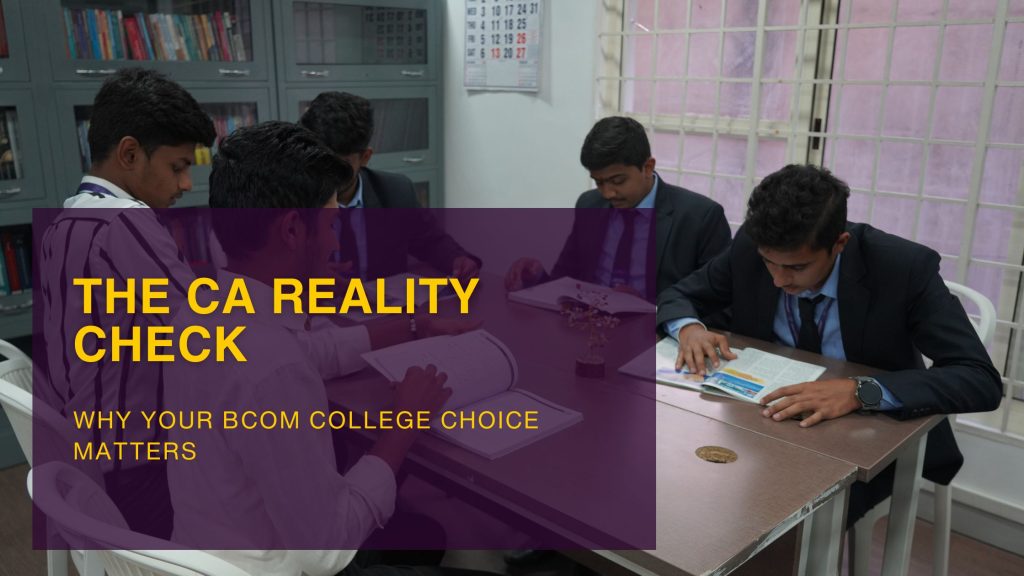
The CA Reality Check: Why Your BCom Choice Matters
Most students underestimate the structural demands of pursuing BCom and CA simultaneously.
The typical scenario without integration:
- College classes from 9 AM to 4 PM
- Rush to CA coaching center
- Evening classes from 5 PM to 8 PM
- Self-study from 9 PM onwards
- Weekends split between college assignments and CA revision
- CA exam month arrives: choose between attending college or intensive revision
- Stress compounds across three years
The integrated scenario:
- BCom curriculum already covers CA Foundation/Intermediate topics
- No separate coaching center commute
- Exam schedules coordinated (or at least not conflicting)
- Peer group shares the same goal
- Faculty understand CA requirements
- Leave policies accommodate CA exam preparation
The difference isn’t just convenience – it’s sustainability. CA requires consistent preparation over years. Burnout kills more CA aspirations than difficulty does.
What “CA Integrated” Actually Means (And What It Doesn’t)
Colleges use “CA integrated” loosely. Here’s what to actually verify:
Genuine Integration
Curriculum alignment:
- BCom syllabus incorporates CA Foundation and CA Intermediate topics
- You study once for both exams, not twice separately
- Subjects like Accounting, Law, Taxation, and Economics are taught at CA depth, not just graduation level
Schedule coordination:
- Class timings leave space for revision
- No attendance penalties during CA exam months
- Internal exam schedules don’t clash with CA exam dates
Built-in coaching:
- CA faculty teach relevant BCom subjects
- Mock tests, MCQ practice, and CA-pattern preparation happen within college
- No need for separate coaching center enrollment
Institutional support:
- ICAI registration guidance
- Articleship placement assistance
- Alumni network of qualified CAs
False Integration (Marketing Only)
What to watch out for:
- “CA coaching available” (meaning: there’s a coaching center nearby)
- “CA-focused curriculum” (meaning: nothing specific, just commerce)
- “Our students pursue CA” (meaning: some do, without any structured support)
- “CA faculty visits” (meaning: occasional guest lectures, not regular teaching)
How to verify:
Ask directly: “Is CA coaching included in fees, or is it separate?” If it’s separate, you’re essentially at a regular BCom program that happens to mention CA.
The BCom + CA Timeline: Understanding the Journey
For students starting BCom and CA together:
Year 1 (BCom First Year + CA Foundation):
- Register for CA Foundation after 12th
- BCom starts July, CA Foundation exam in May/September/January
- Ideal: Clear Foundation by end of first BCom year
- Challenge: Managing two new systems simultaneously
Year 2 (BCom Second Year + CA Intermediate Preparation):
- Start CA Intermediate preparation after Foundation
- ICITSS (4-week IT and orientation training) mandatory
- Group 1 and Group 2 preparation begins
- Challenge: Intermediate has 8 papers, workload increases significantly
Year 3 (BCom Third Year + CA Intermediate Attempts + Articleship Start):
- Complete CA Intermediate (ideally both groups)
- Begin 3-year articleship (practical training)
- Complete BCom graduation
- Challenge: Balancing articleship, graduation exams, and any pending CA papers
Post-BCom:
- Continue articleship
- Prepare for CA Final
- Complete Advanced ICITSS before Final attempt
Total timeline to CA qualification from 12th: typically 4.5 to 5.5 years (if everything goes to plan).
An integrated BCom program compresses the learning overlap and reduces wasted time – critical when the timeline is already this long.
8 Factors to Evaluate BCom Colleges for CA Aspirants
Factor 1: Is CA Coaching Actually Integrated or Just Adjacent?
Ask these questions:
- Is CA coaching fee included in BCom fee, or separate?
- Who teaches CA subjects – college faculty or external coaching?
- Are CA mock tests part of college schedule or extra?
- Do BCom internal exams use CA-pattern questions?
Red flag: If you need to pay separately and travel separately for CA coaching, integration exists only in name.
Green flag: Single fee structure, single timetable, CA and BCom taught by same faculty.
Factor 2: Attendance and Leave Policies
CA exams require intensive preparation in the weeks before. If your college has strict attendance policies with no CA accommodations, you’re fighting the system instead of using it.
What to look for:
- Special leave provisions for CA exam months
- Flexible attendance requirements for CA aspirants
- No internal exams scheduled during CA exam windows
- Understanding faculty who adjust workload pre-CA exams
Ask directly: “What happens to attendance if I need leave before CA exams?”
Factor 3: Faculty Who Understand CA
The best BCom faculty for CA aspirants aren’t just subject experts – they understand ICAI’s expectations.
Ideal faculty profile:
- Qualified CAs teaching relevant subjects (Accounting, Audit, Law, Tax)
- Regular engagement with ICAI updates and syllabus changes
- Experience teaching to CA exam patterns, not just college exam patterns
- Network in CA profession for articleship guidance
How to verify:
- Ask about faculty qualifications during campus visit
- Check if faculty profiles mention CA qualification
- Talk to current students about teaching quality for CA subjects
Factor 4: Peer Group and Support System
CA is a lonely journey if you’re the only one in your batch pursuing it. Studying alongside peers with the same goal creates accountability, resource sharing, and emotional support.
What strong peer support looks like:
- Dedicated CA batch within BCom program
- Study groups forming naturally
- Seniors who’ve cleared CA stages available for guidance
- Healthy competition that pushes everyone
What to avoid:
- Being the only CA aspirant in a general BCom batch
- No interaction between different CA-stage students
- No senior mentorship system
Factor 5: Track Record (The Proof)
Claims are easy. Results are hard.
What to ask:
- How many students from last batch cleared CA Foundation?
- How many cleared Intermediate (both groups)?
- Any AIRs (All India Ranks) from the college?
- Average attempts students take to clear each level?
What good looks like:
- College tracks these numbers and shares willingly
- Pass rates visibly above national averages
- Recent rankers or toppers
Red flag: Vague responses like “many students pursue CA” without specific numbers.
Factor 6: BCU Affiliation and Recognition
Your BCom degree must be valid. For BCom colleges in Bangalore, Bengaluru City University (BCU) affiliation is standard.
Why this matters for CA:
- ICAI recognizes BCU-affiliated BCom for direct entry to CA Intermediate
- 55% in BCom (commerce) qualifies for CA Intermediate direct entry
- Unrecognized degrees complicate your CA registration
Always verify affiliation status before applying.
Factor 7: Articleship Support
Articleship (3-year practical training under a practicing CA) is mandatory for CA qualification. While articleship typically begins during or after BCom, some colleges provide support:
What support looks like:
- CA firm connections for articleship placement
- Alumni CAs who take in articleship students
- Guidance on choosing articleship (Big Four vs. small firm trade-offs)
- Flexible class schedules once articleship begins
Colleges with strong CA alumni networks often have better articleship placement support.
Factor 8: Infrastructure for Sustained Study
CA preparation requires long hours. Good infrastructure makes this sustainable.
What helps:
- Library with extended hours
- Quiet study spaces available
- Access to ICAI study materials and resources
- Computer labs for IT training requirements
- Air-conditioned, comfortable study environments
Small comfort factors compound over three years of intense preparation.
B.Com Specializations for CA Aspirants
Not all BCom variants serve CA aspirants equally:
B.Com (CA Integrated) / B.Com (Professional):
- Specifically designed for CA pathway
- Maximum syllabus overlap with CA Foundation and Intermediate
- Usually includes integrated coaching
B.Com (Accounting & Finance) / B.Com (Honours):
- Deep accounting focus aligns well with CA
- More rigorous than general BCom
- Good foundation even without integration
B.Com (General):
- Works, but no special CA advantage
- Requires entirely parallel CA preparation
- Common choice, but harder path
B.Com (Computer Applications) / Other Specializations:
- Less relevant for CA
- Still valid for CA Intermediate direct entry
- But requires more self-study to bridge gaps
For pure CA focus, B.Com (CA Integrated) or B.Com (Accounting & Finance) are optimal.
Arihant Group of Institutions offers B.Com programs with CA/CS integration, combining BCU-affiliated degrees with structured professional exam preparation – the kind of integration that actually reduces friction.
The Psychological Dimension: What Nobody Tells You
Beyond logistics, your BCom environment shapes your CA mindset.
Positive environment markers:
- CA success stories visible (alumni achievements displayed)
- Faculty who’ve cleared CA understand the struggle
- Culture that normalizes multiple attempts
- Focus on learning, not just passing
Negative environment markers:
- Stigma around failing CA exams
- Faculty dismissive of CA difficulty
- No visible CA success stories
- Pure focus on graduation completion, CA treated as “extra”
CA has brutal pass rates. Most students don’t clear in first attempt. The environment that supports you through failures matters as much as one that celebrates success.
Beyond Integration: Building Your Own Edge
Even in the best-integrated program, individual effort determines outcomes.
What successful CA + BCom students do:
- Start Foundation preparation immediately after 12th (don’t wait for college to begin)
- Use ICAI study materials as primary source (regardless of coaching quality)
- Practice MCQs daily (Foundation and Intermediate are heavily MCQ-based)
- Maintain consistent study schedules rather than cramming
- Join online CA communities for additional support
- Accept that multiple attempts may be necessary
What to avoid:
- Expecting college alone to prepare you (integration helps, but self-study is irreplaceable)
- Ignoring BCom completely (55% required for CA Intermediate direct entry)
- Taking too many attempts at Foundation (time lost compounds)
- Starting articleship without Intermediate clearance strategy
FAQs
- Can BCom graduates directly appear for CA Intermediate?
Yes. Under ICAI’s Direct Entry Scheme, BCom graduates with minimum 55% marks can skip CA Foundation and register directly for CA Intermediate. This saves time and accelerates the CA journey. You’ll need to complete ICITSS (4-week training) before appearing for Intermediate.
- What is the difference between CA Integrated BCom and regular BCom?
CA Integrated BCom combines BCom curriculum with CA Foundation/Intermediate coaching, aligning schedules, reducing overlap, and providing CA-specific teaching. Regular BCom is a standalone degree – you pursue CA coaching separately, manage two schedules, and often study overlapping content twice.
- How long does it take to become CA after BCom?
Minimum 3-3.5 years after BCom completion (for those who clear all exams in first attempt). Realistically, 4-5 years post-BCom for most students, accounting for multiple attempts and articleship completion.
- Is coaching necessary for CA, or can I self-study during BCom?
ICAI’s own study materials are comprehensive, and many students clear with self-study. Coaching helps with structured preparation, doubt resolution, and exam strategy. Integrated programs provide coaching within BCom structure. For self-study, discipline and consistency become critical.
- What should I ask during college visit about CA support?
Ask: How many students cleared CA Foundation last year? Is coaching included in fees or separate? What are attendance policies during CA exam months? Who teaches CA subjects – qualified CAs or general faculty? Do you help with articleship placement?
- How important is BCom percentage for CA?
55% is the minimum for CA Intermediate direct entry. Beyond this, BCom percentage doesn’t directly affect CA registration or exams. However, strong BCom performance indicates concepts are clear – which helps in CA preparation.
- Should I start CA Foundation during 12th or after joining BCom?
Start during 12th if possible. Register after 12th board exams, and you can attempt Foundation in the first year of BCom. Earlier start means earlier finish – the CA timeline is long enough without delays.