
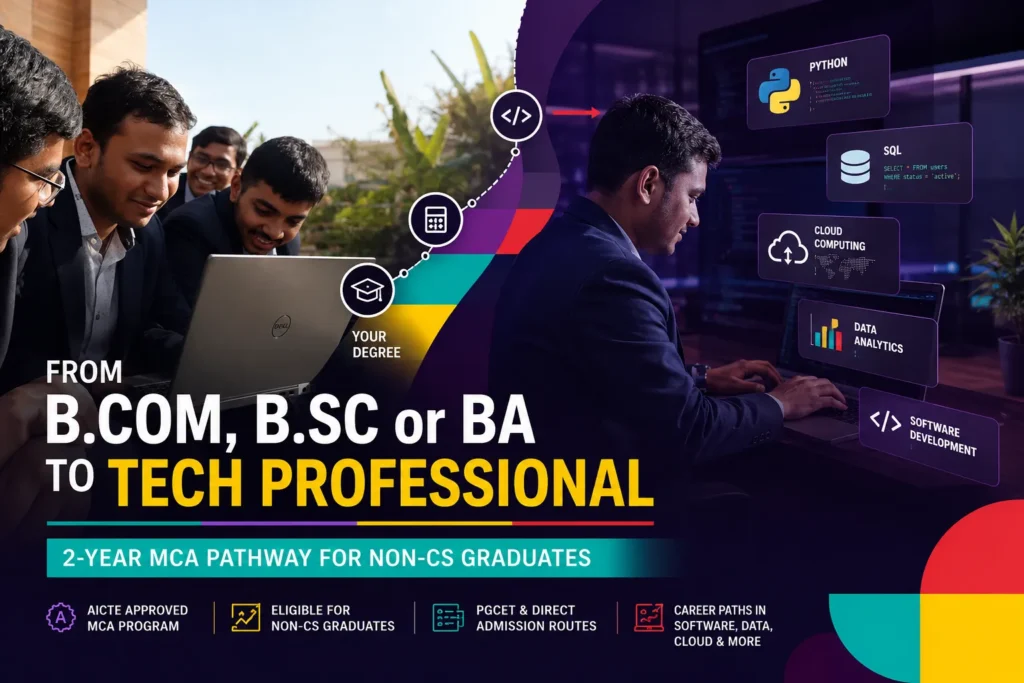
Arts graduates are enrolling in MCA programs – and walking out as software developers, data analysts, and cloud engineers.
The reason is simple. A 2-year MCA in Bangalore is one of the few legitimate paths that takes a non-tech graduate and drops them straight into India’s largest tech ecosystem, with the credentials to back it up.
But the path isn’t obvious. Eligibility rules confuse most applicants. The first semester breaks unprepared students. And the gap between a 4 LPA placement and a 9 LPA one comes down to choices made before enrolment.
This guide decodes who’s actually eligible, how to survive the first semester, and which career paths an MCA in Bangalore opens for non-CS graduates.
Can You Do MCA Without a Computer Science Background? The Eligibility Reality
The biggest myth about MCA is that it’s only for BCA graduates. AICTE’s 2026 norms keep the door wide open: any graduate with Mathematics or Statistics studied at either 10+2 or graduation level is eligible to apply.
Here’s how that plays out across streams.
| Graduation Stream | Eligible? | Key Condition |
| B.Sc (Maths, Stats, CS, IT, Physics) | Yes | Strongest base; direct eligibility |
| B.Com | Yes | Maths at 11th-12th or graduation |
| BBA | Yes | Maths as a subject during BBA or 10+2 |
| BCA | Yes | Standard feeder route |
| BA (Maths, Economics, Statistics) | Yes | Maths as a graduation subject |
| BA (Pure Arts, no Maths) | Conditional | Some universities require a bridge course |
Bangalore City University (BCU), the affiliating body for most of the city’s MCA programs, follows AICTE rules. Most autonomous and deemed universities follow the same framework, sometimes with minor variations on bridge-course requirements.
The practical takeaway: if you studied maths at any point – Class 11, Class 12, or graduation – you have a viable path into an MCA in Bangalore.
PGCET vs Direct Admission – The 2 Routes Into Bangalore MCA Programs
Two routes lead into MCA programs in Karnataka, and each has different rules for non-CS applicants.
Route 1: Karnataka PGCET
The Postgraduate Common Entrance Test is conducted by KEA (Karnataka Examinations Authority). It is the standard entry point for all government and government-quota seats in Karnataka MCA colleges.
- Eligibility: 50% in graduation (45% for reserved categories), with Maths at 10+2 or graduation.
- Syllabus weight: Mathematics (60 marks), Analytical Ability (30 marks), Computer Awareness (30 marks).
- Timing: Usually conducted in June-July; results within 2 weeks.
- Who should take it: Anyone targeting government colleges or scholarship-eligible seats.
Route 2: Management Quota & Direct Admission
Most BCU-affiliated and autonomous colleges in Bangalore – including AGI – accept direct admissions for management quota seats. This route is especially useful for non-CS graduates who didn’t appear for PGCET.
- Eligibility: Same AICTE rules apply.
- Process: Application, document verification, sometimes a short interview.
- Timing: Applications open from May; seats fill on a rolling basis through July-August.
A realistic June-to-August admission timeline for 2026:
- June: PGCET application + management quota applications open.
- Early July: PGCET exam conducted.
- Mid-July: Results, counseling rounds begin.
- August: Final allotments, fee payment, classes commence.
Non-CS applicants without PGCET typically secure faster admission via the direct route, with structured support for first-semester foundations.
The First-Semester Survival Plan for Non-CS Switchers
The first semester is where unprepared switchers struggle. BCA graduates walk in already comfortable with C, basic data structures, and database queries. A B.Com or B.Sc Maths graduate is starting from zero on programming logic.
The good news: the gap closes faster than most people expect. Here’s the honest version of what helps.
6-week pre-MCA self-prep:
- Python basics: Variables, loops, functions, lists, dictionaries (free CS50P, freeCodeCamp resources).
- SQL fundamentals: SELECT, JOIN, GROUP BY – enough to query a database.
- Terminal and Git basics: Comfortable navigating files, basic version control.
- Logic-building: 30-50 problems on HackerRank or LeetCode Easy.
What strong Bangalore MCA programs add structurally:
- Foundation modules: Programming basics taught from scratch in week 1-4.
- Lab-heavy first semester: 8-10 hours of hands-on coding per week.
- Faculty office hours: Direct access for students from non-CS backgrounds.
- Peer mentoring: BCA-stream students often mentor non-CS classmates.
At AGI Global Campus, the first-year structure is built around this exact gap. Foundation modules in semester one assume a mixed-background cohort, and lab hours are weighted heavily toward practical implementation rather than theory.
The students who fail aren’t the non-CS ones. They’re the ones who skip the pre-prep and assume MCA will start from absolute zero. It won’t.
From B.Com / B.Sc to Tech Roles – 5 Career Paths That Open Up After MCA in Bangalore
An MCA in Bangalore isn’t a single career path. It’s a credential that splits into multiple roles depending on what electives, projects, and internships you stack on top.
For non-CS graduates, five paths consistently work.
- Software Developer (Full-Stack / Backend): The most common route. Entry roles in Java, Python, or Node.js stacks. Starting salaries in Bangalore: 4-6.5 LPA for product MNCs and mid-tier IT services.
- Data Analyst / Junior Data Scientist: Strong fit for B.Sc Maths and B.Com switchers – math background is an actual asset. SQL, Python, and Power BI proficiency unlocks roles in fintech, analytics consultancies, and GCCs. Starting: 4.5-7 LPA.
- Cloud Engineer (Entry-Level): AWS or Azure certifications stacked with MCA opens DevOps and cloud support roles. Bangalore has the densest cloud-hiring market in India. Starting: 5-7 LPA.
- QA Engineer / Test Automation: Underrated entry point. Automation testing with Selenium, Cypress, or Playwright pays well and has lower competition than dev roles. Starting: 4-6 LPA.
- Business Analyst: Particularly strong for B.Com switchers – domain knowledge in finance, accounting, or operations layered with MCA’s tech foundation makes you a natural fit for BA roles in consulting, banking tech, and SaaS. Starting: 5-8 LPA.
The realistic salary band for non-CS MCA graduates from a structured Bangalore college is 4.5-8 LPA at entry level, with strong portfolios pushing into 9+ LPA territory.
What to Look for in an MCA College in Bangalore (As a Switcher)
For non-CS applicants, college selection criteria are different from what most aggregators rank by. Brand prestige matters less than structural support.
Five things that matter more than rankings:
- Foundation module strength: Does the first semester assume CS knowledge or build it from scratch?
- Lab-to-theory ratio: More lab hours = faster skill build for switchers.
- Internship structure: Is industry internship in semester 4 mandatory and structured, or optional and ad-hoc?
- Industry tools exposure: AWS, Azure, GitHub, Power BI, Tableau – are these taught or just listed?
- Placement cell engagement: Does the placement cell start preparing you in semester 1 or wait until semester 4?
Questions to ask before enrolling:
- What percentage of last year’s MCA cohort came from non-CS backgrounds?
- What’s the average package for those students?
- Are foundation modules taught by core faculty or part-time tutors?
- What’s the structure of the capstone project and internship pipeline?
Honest answers to these questions separate strong colleges from brochure-heavy ones.
Key Takeaways
- Non-CS graduates with Mathematics at 10+2 or graduation are eligible for MCA in Bangalore under AICTE rules.
- Karnataka PGCET or direct admission via management quota are the two main routes; non-CS applicants often prefer the direct route.
- A 6-week pre-MCA prep in Python, SQL, and Git closes most of the first-semester gap.
- Five career paths open up after MCA: developer, data analyst, cloud engineer, QA, business analyst.
- Starting salaries range from 4.5 to 8 LPA; strong portfolios push higher.
- Foundation module structure and lab-to-theory ratio matter more than rankings for non-CS switchers.
Frequently Asked Questions About MCA in Bangalore
1. Can a B.Com graduate do MCA in Bangalore?
Yes. Under AICTE 2026 norms, any graduate with Mathematics or Statistics studied at 10+2 or graduation level is eligible for MCA in Bangalore. B.Com graduates who had maths in 11th-12th qualify directly. Most BCU-affiliated colleges, including AGI Global Campus, accept B.Com applicants without additional bridge requirements.
2. Is MCA difficult for students without a computer science background?
The first semester is challenging but not unmanageable. With 6 weeks of pre-MCA preparation in Python, SQL, and basic Git, most non-CS graduates close the gap by mid-semester one. Colleges with structured foundation modules and lab-heavy first semesters make the transition significantly smoother.
3. What is the salary for non-CS MCA graduates in Bangalore?
Entry-level salaries for non-CS MCA graduates in Bangalore range from 4.5 to 8 LPA depending on specialisation, internship quality, and capstone project. Graduates with strong portfolios in cloud, data analytics, or full-stack development frequently cross 9 LPA at their first role.
4. Which entrance exam is required for MCA in Karnataka?
Karnataka PGCET (conducted by KEA) is the primary entrance exam for MCA in Bangalore admissions. It tests Mathematics, Analytical Ability, and Computer Awareness. Non-PGCET applicants can also secure admission via management quota at most autonomous and BCU-affiliated colleges, including AGI.
5. How many years is MCA in Bangalore and what’s the structure?
MCA in Bangalore is a 2-year postgraduate program split into 4 semesters. The structure typically includes core programming and theory in semesters 1-2, electives and specialisations in semester 3, and a mandatory industry internship plus capstone project in semester 4.
Take the Next Step
Curious about the MCA pathway for non-CS graduates? AGI Global Campus offers a BCU-affiliated 2-year MCA in Bangalore with structured first-year foundation modules, industry-grade lab infrastructure, and placement support through IIPC (Industry Institute Partnership Cell).
Visit agiedu.in or call +91 92363 63636 to know more.
According to the All India Council for Technical Education (AICTE), graduates meeting the eligibility criteria can pursue an MCA program.
Students applying through Karnataka PGCET should check the latest notifications on the KEA website.