
Key Takeaways
- A BCA degree and online courses serve different purposes. A degree provides structured education and a recognised qualification, while online courses help develop specific skills.
- For many commerce students, combining a BCA with selected online courses can provide both a foundation and practical experience.
- Online courses alone may suit people who already have a degree and can study independently.
- Employers have different requirements. Review current job listings for your target role before deciding.
- Build projects alongside your learning so you can demonstrate your skills to potential employers.
You studied commerce, but now you want to build a career in technology. When you research your options, you may encounter two different opinions. One says you need a degree because employers screen candidates by qualification. The other says a few online coding courses are enough to get started.
Both approaches can work in certain circumstances. The right choice depends on your educational background, budget, career goals and ability to learn independently.
If you are exploring a BCA course for commerce students, this guide compares a degree with online courses and explains how to decide which route makes sense for you.
What Does Each Route Actually Offer?
Before choosing, understand what you gain from each option.
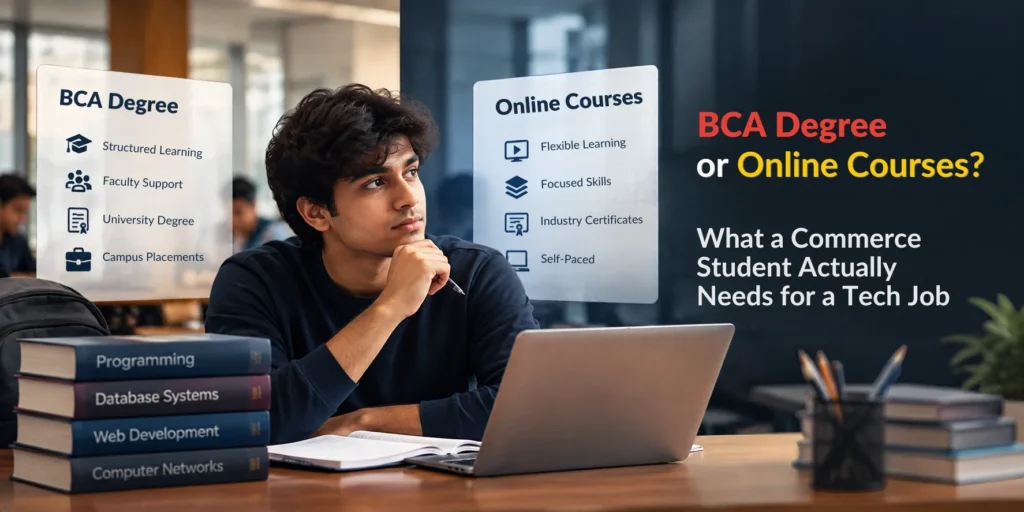
| Factor | BCA degree | Online courses |
|---|---|---|
| Time | Usually a multi-year degree; confirm the current programme duration | Weeks or months, depending on the course |
| Cost | Tuition and other college expenses over the programme | Often lower upfront, but multiple courses can add up |
| Qualification | A degree awarded under the applicable university framework | Certificates whose value varies by provider and course |
| Learning depth | Structured study of computing fundamentals and related subjects | Focused learning in selected tools or skills |
| Accountability | Timetables, faculty, assessments and classmates | Requires self-discipline and personal planning |
| Practical work | May include labs, assignments and projects | Depends on the course and the projects you complete |
| Career support | May include placement assistance and campus opportunities | Usually requires you to seek opportunities independently |
Neither route guarantees employment. Your choice should reflect what your target employers require and the learning environment in which you are most likely to succeed.
What Do Entry-Level Technology Employers Look For?
Start by reviewing current job advertisements for roles that interest you, such as junior software developer, QA tester, data analyst, web developer or technical support engineer.
Look beyond the job title. Read the eligibility requirements, preferred qualifications, technical skills and project expectations.
Some employers specify a degree in computer applications, computer science or a related field. Others may place greater emphasis on demonstrable skills and practical experience. Requirements vary by employer and role.
A degree alone does not demonstrate that you can perform a job, and an online certificate alone does not establish that you have mastered a skill. Practical projects, problem-solving ability and interview performance also matter.
Before enrolling, compare at least five current job postings for the roles you want to pursue. Use those requirements to guide your learning plan.
Where Each Learning Route Can Go Wrong
Choosing a Degree Without Building Practical Skills
A student may complete a degree but have few projects to show employers. Avoid waiting until the final semester to gain practical experience.
Start building small projects as soon as you understand the fundamentals. Improve them as you learn more.
Taking Courses Without Completing Projects
Online learning offers flexibility, but it is easy to collect certificates without developing a useful skill set.
Choose a clear learning path, complete the course and build a project that demonstrates what you learned.
Trying to Learn Everything at Once
Moving between programming languages, frameworks and unrelated courses can make progress difficult to measure.
Choose one starting point, practise consistently and move to the next topic only when you have a reasonable grasp of the current one.
Why Commerce Students Can Bring a Different Perspective
A commerce background can be useful in technology. Commerce students may already understand accounting, billing, taxation, inventory, business operations and customer needs.
These concepts can provide ideas for practical software projects.
For example, you could build a simple invoicing tool, expense tracker, inventory dashboard or GST-related calculator for learning purposes. Such projects can demonstrate both your understanding of a business problem and your ability to develop a technical solution.
This combination may be relevant to areas such as accounting software, enterprise resource planning, fintech and business analytics.
The objective is not to discard your commerce knowledge. It is to add technical skills that help you solve practical problems.
A Twelve-Month Starter Plan for Commerce Students
Whether you choose a degree, online courses or both, a structured learning plan can help you make progress.
Months 1–3: Learn Programming Fundamentals
Choose one programming language and learn the basics of variables, conditions, loops, functions and data structures.
Python is one possible starting point. Build small projects such as a calculator, quiz application and basic expense tracker.
Focus on understanding the code rather than copying solutions without knowing how they work.
Months 4–6: Learn Databases and Data Handling
Study basic SQL, spreadsheets and how applications store and retrieve information.
Improve your expense tracker so it can save records and produce a monthly summary. This will help you practise connecting programming concepts with data.
Months 7–9: Choose a Direction
Explore one area that interests you, such as web development, data analysis or software testing.
Choose a suitable course or guided project and follow it from beginning to end. Avoid switching directions every few days.
Months 10–12: Build a Commerce-Related Project
Create a project that connects your commerce knowledge with your technical skills.
Ideas include a simple invoicing application, expense-management dashboard or educational tax calculator. Clearly explain the problem your project solves and document how it works.
By the end of the year, aim to have at least one completed project you can demonstrate and discuss in an interview.
The Five-Question Test: Should You Choose BCA or Online Courses?
Answer these questions honestly before deciding.
- Are you completing school or already hold a degree? A BCA may provide a relevant undergraduate qualification for someone starting higher education. Someone who already has a degree may have different needs.
- Do you need a structured learning environment? If regular classes, faculty support and assessments help you stay consistent, a degree programme may suit you.
- What do your target employers require? Check the eligibility criteria in current job postings before choosing a route.
- How quickly do you need to start earning? Online courses can help you focus on selected skills quickly, but learning alone does not guarantee a job.
- Do you want to keep further-study options open? Check the eligibility requirements for postgraduate programmes and other career routes you may consider.
If you are beginning your higher education and prefer structured learning, a BCA may be a suitable foundation. If you already have a degree and can study independently, focused online courses may be a practical option. Verify the requirements for your intended career before making a final decision.
Why Combining a BCA with Online Courses Can Work
For students who have the time and resources, the choice does not always have to be one or the other.
A BCA can provide structured learning in computing fundamentals, while selected online courses can help you explore a specific skill or technology in greater depth.
During the first year, concentrate on programming basics and logical thinking. In the second year, consider a focused area such as web development, data analysis or software testing. By the third year, aim to complete a substantial project that brings together your technical knowledge and understanding of business.
The key is to avoid overloading your schedule. Choose courses that complement your degree rather than competing with it.
Choosing a BCA College in Bangalore
When comparing BCA colleges in Bangalore, consider more than the course title or advertised placement figures.
Check the Programme and Eligibility
Review the current BCA eligibility criteria, programme duration, curriculum and admission requirements. Commerce students should specifically confirm whether their mathematics background meets the applicable eligibility rules.
Review Labs and Practical Learning
Ask about laboratory facilities, programming assignments, project work and opportunities to develop practical skills. Confirm the details with the institution rather than relying on general promotional claims.
Understand Placement Support
Ask what support the placement cell provides, including career guidance, interview preparation, internships and recruitment opportunities.
Placement assistance does not guarantee a job, so review the available information carefully and ask how students can build their own portfolios alongside their coursework.
Ask About Support for Commerce Students
If you are new to programming, ask how introductory computing subjects are taught and what academic support is available during the first semester.
AGI Education offers a BCA programme through its Global Campus. You can review the AGI Education BCA programme page and contact the admissions team to confirm the current curriculum, eligibility criteria, lab facilities and support for commerce students.
Frequently Asked Questions
Can a commerce student do BCA?
In many institutions, commerce students can apply for BCA, but eligibility requirements differ. Confirm the current admission criteria and any mathematics requirements with the institution before applying.
Are online courses enough to get a technology job?
They can help develop relevant skills, particularly for people who already have a degree and can learn independently. However, hiring requirements vary, so check the qualifications and practical skills requested for your target roles.
Is BCA better than a short coding course?
They serve different purposes. BCA provides a structured degree programme, while a short course focuses on particular skills. The right option depends on your existing qualifications, career goals and learning preferences.
Do companies hire BCA graduates?
Some employers recruit BCA graduates for technology-related roles, depending on their eligibility criteria and the candidate’s skills. Practical projects, communication, problem-solving and interview performance can also matter.
Which is cheaper: BCA or online courses?
Online courses generally have lower upfront costs, but the total cost depends on the provider and number of courses. A BCA involves college tuition and other expenses over the programme. Compare the full costs and the learning support each option provides.
How can I learn about AGI Education’s BCA programme?
Visit the AGI Education BCA programme page or contact the admissions team through the AGI Education enquiry page. Ask about eligibility, the current syllabus, laboratory facilities, academic support and fees.
Get More Information About the BCA Programme
Considering a BCA after commerce? Speak with the admissions team to understand the programme, eligibility criteria, laboratory facilities and support available to students who are new to computing.
Corporate Campus – VV Puram
#148, R.V. Road, VV Puram, Bengaluru
Phone: +91 80 43770027
Global Campus
#2/1237, Thalaghattapura, Opp. Metro Pillar 275, Bengaluru
Phone: +91 80 28435447
For programme information, visit the AGI Education BCA page or the enquiry page.
Choose the route that fits your educational background, career goals and budget. Whichever path you take, begin building practical skills and projects early so you can show employers what you have learned.