
Most students choose among BCA colleges in Bangalore by scrolling a ranking table – fees, an average package, a logo they recognise. That table quietly hides the two things that actually shape your three years: the labs you will build in, and the people who will teach you.
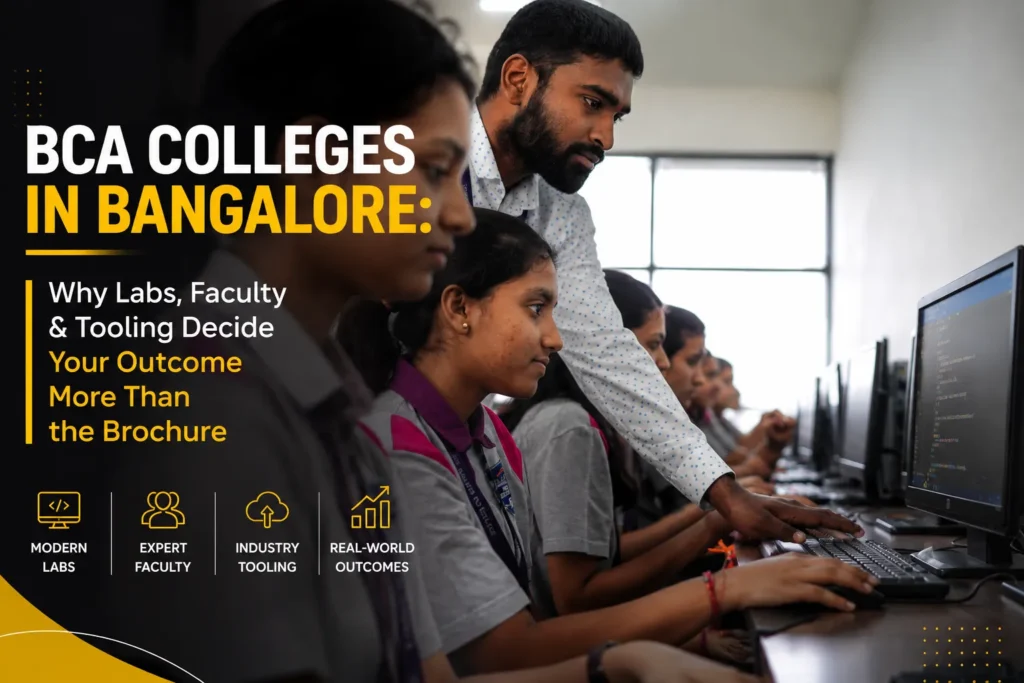
A brochure can promise an “industry-ready” experience. Only the infrastructure and faculty behind it can deliver one.
This guide flips the usual checklist. Instead of ranking BCA colleges in Bangalore by reputation, it shows you how to read a campus the way a recruiter eventually will – by the tooling students touch and the experience of the people guiding them. Use it to compare BCA colleges in Bangalore on what compounds over three years, not on what looks good on a banner.
Infrastructure and Faculty Beat the Brochure – Here’s Why
When evaluating BCA colleges in Bangalore, infrastructure and faculty matter more than rankings because they decide what you can actually practise. A modern lab lets you build real projects; an industry-experienced teacher turns a syllabus into a job-ready skill. Brochures describe outcomes – labs and faculty produce them.
Bangalore’s advantage is genuine. The city is India’s largest technology hub, with more than 10,000 IT companies, so a BCA here sits minutes from the firms that may one day hire you.
But proximity to IT companies only pays off if your campus trains you to walk in ready. That readiness is built in labs and code reviews, not in lecture slides.
Think of it as a three-year compounding effect. A slightly better lab and a slightly more experienced mentor each semester add up to a graduate who has built more, debugged more, and walks into interviews with proof rather than promises.
The Lab and Tooling Test: What “Tech Infrastructure” Actually Means
“Modern infrastructure” is the most overused line in any prospectus. Turn it into questions you can verify on a campus visit.
Tech infrastructure for a BCA is not about how new the buildings look. It is about how much hands-on computing time each student gets, and whether the tools match what employers actually use.
Hardware and lab access
Ask how many students share a machine, and whether labs stay open beyond scheduled class hours. A lab you can only enter during a fixed period limits the very practice that builds skill.
The strongest BCA colleges in Bangalore treat lab time like gym time – available, repeatable, and student-led.
Open labs also quietly decide your internship odds. The students who build the most are the ones with a portfolio to show when Bangalore’s IT companies come hiring, long before final-year placement season begins.
The software stack students actually touch
A degree is only as current as the tools behind it. Before you enrol, confirm that students work with the following, not just textbook compilers:
- Programming environments for Java, Python and modern web frameworks used in real development.
- Database systems – both SQL and NoSQL – queried on real datasets, not toy examples.
- Cloud access for deployment, so projects run live rather than only on a local screen.
- Version control with Git, used the way working development teams actually use it.
- Exposure to AI-assisted coding and analytics tools, now a standard expectation in 2026 hiring.
According to AGI’s computer-science faculty, the gap between a confident graduate and a nervous one is rarely talent – it is how many times they shipped something that actually ran.
There is a simple proxy for all of this. Ask to see a project a current student deployed; a campus that can show you running software, not just slides about it, is one where the labs and tooling are doing their job.
The Faculty Test: Who’s Teaching You, and Why It Compounds
Infrastructure gives you the gym. Faculty are the coaches. Over three years, the coaches matter more.
Industry experience versus theory-only
A teacher who has shipped software explains why a concept matters, not just what it is. They bring code reviews, real architecture, and the standards a workplace will expect of you.
Ask whether faculty have worked in or with the IT industry, and whether they still stay connected to it.
There is a second, less obvious benefit. Faculty who stay close to the industry know which skills are quietly going out of date – and they tend to redesign labs before the official syllabus catches up.
Research, mentorship and ratios
Who guides your projects shapes how employable you become. These signals separate a mentoring culture from a clock-out one:
- Faculty with research publications stay current with where computing is heading.
- Smaller mentor-to-student ratios mean your code gets reviewed, not just graded.
- Project guidance – not only lectures – is where real employability is built.
- Access to faculty outside class hours signals genuine mentorship.
Ratios are easy to verify and hard to fake. In a smaller cohort, a teacher can actually read your code, flag the lazy shortcut, and push you toward the cleaner solution – the kind of feedback that turns a passable project into a portfolio piece.
A Practical Comparison Framework
Use this to compare any shortlist of BCA colleges in Bangalore without falling for marketing. For each line, do not accept the claim – verify the proof on campus.
The pattern is consistent: every impressive claim has a verifiable counterpart. Treat the left column as marketing, and the right column as your campus-visit checklist.
| The brochure says | What to actually verify | Why it matters |
|---|---|---|
| State-of-the-art labs | Student-to-machine ratio; open-lab hours | Practice time, not optics |
| Expert faculty | Industry experience; research; office hours | Mentorship compounds over 3 years |
| Industry-ready curriculum | Cloud, Git, real datasets, AI tools | Matches 2026 hiring |
| Placement support | Live projects, internships, a real cell | A pipeline, not a promise |
| Modern campus | Proximity to IT firms; live-project tie-ups | The Bangalore advantage, realised |
How Arihant’s BCA Is Built Around Labs and Faculty
Arihant Group of Institutions (AGI) runs its BCA under the Arihant Institute of Commerce & Management (AICM), affiliated to Bengaluru City University and AICTE-approved.
The NEP-aligned (3+1 year) program is taught across the Corporate Campus in VV Puram and the Global Campus in Thalaghattapura, the latter adding advanced labs and research spaces. In practice, that setup is built around the factors above:
- Computer labs equipped with current software and hardware, alongside smart, technology-enabled classrooms.
- A curriculum spanning programming and software development, database management, web technologies, data structures and algorithms, and computer networks and security.
- Faculty who combine subject expertise with research publications and industry experience.
- Live projects and internships through industry partnerships, with dedicated placement support via the Industry Institute Partnership Cell (IIPC).
- Clear routes after BCA – software and web development, database administration, system analysis, cybersecurity, or higher study through an MCA.
AGI’s positioning is deliberately modest: the campus provides the labs and the mentors; the three years are still yours to build.
Because the program spans both campuses, students can also pick the setting that suits them – the central, professional environment of VV Puram, or the expanded labs and research spaces at the Global Campus.
Key Takeaways
- Rankings tell you reputation; labs and faculty tell you outcome.
- Verify student-to-machine ratios and open-lab hours, not brochure adjectives.
- A modern software stack – cloud, Git, real datasets, AI tools – signals 2026 readiness.
- Industry-experienced, research-active faculty compound your skills over three years.
- Among BCA colleges in Bangalore, the real question is not “how ranked?” but “how much will I actually build here?”
FAQs: BCA colleges in Bangalore
| FAQs: BCA colleges in Bangalore |
| 1. What should I look for when comparing BCA colleges in Bangalore? Look beyond rankings at three things: lab access (student-to-machine ratio and open hours), the software stack students actually use, and faculty experience. Together these decide how much you build and how job-ready you become. A campus close to Bangalore’s IT firms adds the live projects and internships that turn classroom learning into employable skill. |
| 2. Does the faculty really matter more than the college’s reputation? Over three years, yes. Reputation gets you noticed; faculty get you ready. Teachers with industry experience explain why concepts matter, review your code, and mentor your projects. That guidance – not a logo – is what a hiring manager eventually tests in an interview. |
| 3. What tech infrastructure should a good BCA program have in 2026? A strong program offers open-access computer labs, current programming environments, SQL and NoSQL databases, cloud deployment, version control with Git, and exposure to AI-assisted coding tools. The aim is repeatable, hands-on practice on tools employers actually use – not just theory on a screen. |
| 4. Is Bangalore a good city to study BCA? Bangalore is India’s largest technology hub, so a BCA here sits close to thousands of IT companies, startups and internships. That proximity only pays off if your college converts it into live projects and placements, which is why infrastructure, faculty and a working placement cell matter as much as the location itself. |
| 5. What career paths open up after a BCA? A BCA can lead to roles in software and web development, database administration, system analysis and cybersecurity, among others. Many graduates also pursue an MCA or other postgraduate study to reach senior technical positions. Your starting point depends heavily on how much practical work you complete during the degree. |
Your Next Step
Don’t choose among BCA colleges in Bangalore on the strength of a brochure. Visit the labs, meet the faculty, and ask how many times you will actually build something that runs.
To see how Arihant’s BCA is taught – and to tour the labs and meet the team – explore agiedu.in or visit a campus.
Enquire: agiedu.in
Corporate Campus: #148, R.V. Road, VV Puram – +91 80 43770027
Global Campus: #2/1237, Thalaghattapura, Opp. Metro Pillar 275 – +91 80 28435447