
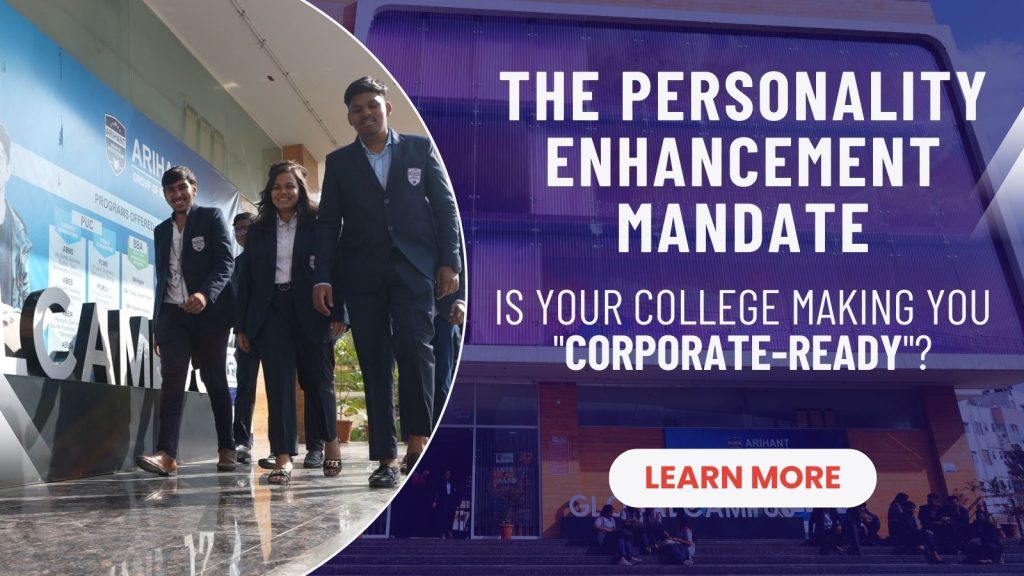
The Illusion of “Finishing School” Readiness
Walk into any personality development class at management colleges in Bangalore and you’ll see a standard formula: spoken English drills, grooming lessons, posture training, dining etiquette, and maybe a mock interview at the end. Colleges proudly label this as “corporate readiness.” But every year, thousands of fresh graduates enter the workplace and realise – within weeks – that none of this prepared them for what actually hits them at work.
Because the real corporate challenges aren’t about how you sit or whether you say “pardon me” instead of “what?”. They’re deeper, messier, and intensely human.
Most early‑career professionals – even those coming from the top management colleges in Bangalore – struggle with things no finishing school even acknowledges:
- Taking feedback without breaking down.
- Handling office politics without losing themselves.
- Setting boundaries with seniors.
- Managing deadlines, stress, and unfair situations.
- Saying “no” respectfully.
- Dealing with team conflicts.
- Recognising and resisting unethical requests.
At Arihant Group of Institutions (AGI), one of the forward‑thinking management colleges in Bangalore, the approach to corporate readiness goes far beyond English fluency or polished etiquette. AGI focuses on the deep personality, emotional, and ethical competencies that determine long‑term career success – not just interview performance.
This article breaks down why superficial PD programs fail, what fresh graduates actually need, and how a Corporate Readiness 2.0 model – like the one AGI champions – can transform a student’s career trajectory. why superficial PD programs fail, what fresh graduates actually need, and how a Corporate Readiness 2.0 model – like the one AGI champions – can transform a student’s career trajectory.
The Shallow Model: Why Traditional PD Training Fails in the Real World
Most management and degree colleges still rely on a cosmetic version of “personality development,” which includes:
- Spoken English practice
- Grooming & dress code sessions
- Dining etiquette workshops
- Basic resume writing
- One or two mock interviews
Useful? Yes. Sufficient? Absolutely not.
The real workplace does not fall apart because someone used the wrong fork. It falls apart when people:
- Get stressed and shut down.
- Lash out when criticised.
- Cannot navigate conflict.
- Stay silent in unfair or unethical situations.
- Don’t understand team dynamics.
- Misread tone, intent, or boundaries.
These are deep skills, not surface‑level behaviours.
And yet, how many management colleges in Bangalore (or anywhere) run sessions on:
- How to handle passive‑aggressive colleagues?
- What to do when a manager takes credit for your work?
- How to push back respectfully when overloaded?
- How to stay emotionally regulated during conflict?
- What constitutes unethical instructions or workplace red flags?
This is where AGI breaks the mould.
The Real Challenges Freshers Face (That No One Prepares Them For)
1. Taking Feedback Without Emotional Meltdown
Most freshers take feedback as a personal attack instead of a growth opportunity. Why? Because they’ve never been taught:
- How to detach ego from work
- How to respond without defensiveness
- How to reframe feedback into next steps
2. Managing Stress, Pressure & Ambiguity
College life is structured. Workplace life is not. Students often crumble because:
- Deadlines overlap
- Managers change requirements last minute
- Expectations feel unclear
Emotional resilience – not grammar – determines success.
3. Understanding Office Politics & Boundaries
“Office politics” isn’t manipulation – it’s:
- Reading power dynamics
- Knowing what to say, when, and to whom
- Maintaining boundaries with seniors
- Protecting your mental space
4. Saying “No” Without Damaging Relationships
Freshers fear:
- Disappointing seniors
- Being seen as incompetent
- Missing out on opportunities
So they say “yes” to everything and burn out.
5. Recognising Ethical vs Unethical Requests
Few colleges teach what to do when asked to:
- Manipulate data
- Hide mistakes
- Work unpaid overtime
- Mislead customers
Ethical courage is a corporate survival skill.
6. Navigating Team Dynamics
Team success depends on:
- Listening
- Negotiation
- Handling conflict
- Sharing credit
Not a single one of these fits into a “spoken English” class.
So What Should Corporate Training Actually Cover?
AGI’s Corporate Readiness Framework focuses on deep psychological and behavioural skill-building, including:
1. Resilience Training
- How to bounce back from criticism
- How to regulate emotion during pressure
- How to manage stress cycles
2. Workplace Ethics & Courage
- Recognising red flags
- Understanding professional vs unethical expectations
- Knowing when (and how) to escalate issues
3. Boundary-Setting & Assertiveness
- Saying no respectfully
- Asking for clarity without fear
- Protecting mental bandwidth
4. Political Intelligence
Not manipulation – situational awareness.
- Understanding invisible hierarchies
- Reading intentions
- Knowing when to speak and when to wait
5. Conflict Resolution
- Techniques to de‑escalate disagreements
- Handling ego clashes professionally
- Working with difficult personalities
6. Emotional Maturity
The foundation of corporate relationships:
- Self-awareness
- Response vs reaction
- Managing personal triggers
- Humility + confidence balance
These are not optional add-ons – they are the real differentiators between those who grow fast in their careers and those who stagnate.
What AGI Does Differently (Subtle but Powerful)
AGI integrates deep skill development into personality enhancement programs rather than treating it as extra credit.
AGI’s Corporate Readiness 2.0 Model Includes:
- Workplace conflict simulations (healthy vs toxic team dynamics)
- Guided reflection circles similar to group therapy (but academic-friendly)
- Case studies of ethical dilemmas in finance, HR, marketing, and tech
- Real-world negotiation exercises
- Boundary-setting roleplay (learning to say no)
- Structured feedback sessions for emotional regulation practice
- Professional behaviour labs that examine tone, intention, empathy
Nothing here is cosmetic. Everything is experiential.
The AGI Advantage
- Students build inner confidence, not scripted answers.
- They learn to handle tough bosses, not just tough interviewers.
- They develop political and ethical intelligence – not just etiquette.
- They transition into the workforce with maturity that outperforms other freshers.
This is what makes AGI graduates workplace-ready in a way most traditional management colleges in Bangalore cannot match.
Personality Development 2.0 – A New Standard for Colleges
If colleges truly want to prepare students for real careers, they must adopt a deeper model.
The New PD Framework Should Include:
- Resilience & Stress Management Training
- Emotional Intelligence Labs
- Ethical Decision-Making Workshops
- Conflict Resolution Simulations
- Assertive Communication Modules
- Negotiation & Workplace Boundaries Training
- Reflection Circles & Mentorship Pods
- Case Studies Based on Real Workplace Scenarios
This is the shift AGI is pushing toward – a move from cosmetic personality polishing to real corporate identity building.
Conclusion: The Future Belongs to the Emotionally Skilled
Corporate success isn’t built on perfect English or polished etiquette. It’s built on:
- Emotional maturity
- Resilience
- Ethics
- Political awareness
- Boundaries
- Reflection
- Self-awareness
- Conflict management
These are the skills that determine whether a fresher becomes a liability or a leader.
AGI understands this deeply, and that’s why its Corporate Readiness programs are not shallow finishing school modules – they are transformative personality and professional development journeys.
Because the workplace no longer rewards those who speak well. It rewards those who think clearly, act ethically, communicate maturely, and navigate complexity with grace.
Those are the professionals AGI aims to build.
Hiring trends from LinkedIn job listings in Bangalore
FAQs
|