
Most MCA brochures in Bangalore list 40+ subjects. None of them tell you what you’ll actually do for two years.
Will you write production code? Build apps from scratch? Touch cloud platforms? Or memorize textbook algorithms for a written exam and forget them by graduation?
The gap between graduates who land 4 LPA roles and those who clear 9 LPA isn’t the college brand on their certificate. It’s what their curriculum forced them to build, ship, and explain to recruiters.
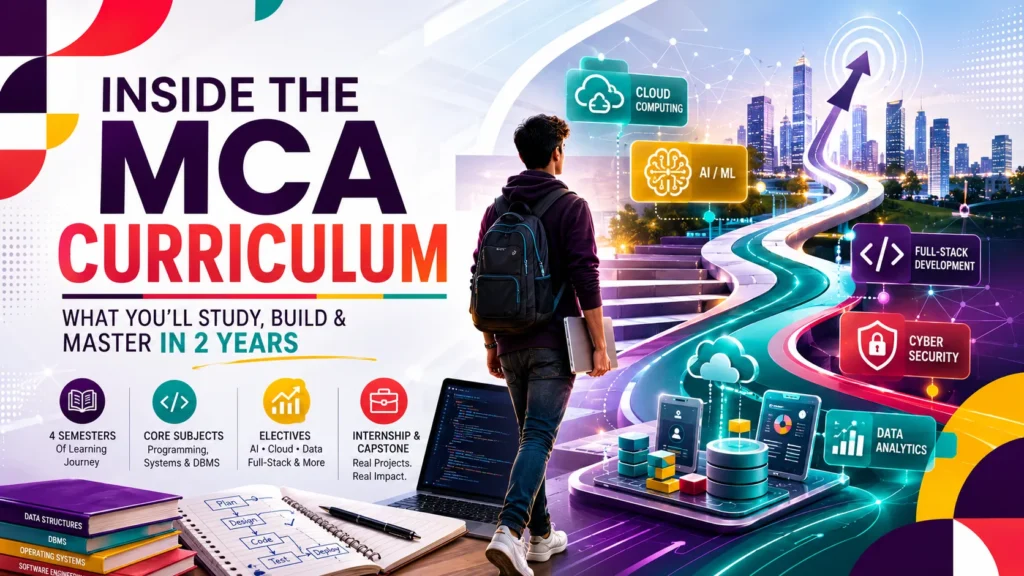
This guide breaks down the real MCA in Bangalore experience – semester by semester. Core subjects, electives that matter, tools you should master, and the capstone phase that decides 70% of placement outcomes.
How the 2-Year MCA in Bangalore Is Actually Structured
A standard 2-year MCA is split into 4 semesters of roughly 6 months each. The structure looks identical across most BCU-affiliated and autonomous colleges.
| Semester | Focus | Subject Load (approx.) |
| Semester 1 | Programming foundations + theory | 7-8 core subjects |
| Semester 2 | Advanced programming + data systems | 6-7 core subjects |
| Semester 3 | Electives + live projects + specialisation | 4 core + 2-3 electives |
| Semester 4 | Industry internship + capstone project | 1 capstone + internship |
The metric that brochures hide isn’t the subject count – it’s the lab-hour-to-theory-hour ratio. Strong programs run 8-12 lab hours per week in semester 1. Weak ones run 2-3.
BCU’s MCA framework sets a baseline of 60% theory and 40% practical. Better colleges flip that ratio in semesters 2 and 3, weighting heavily toward hands-on coding, system design, and project work.
Semester 1 & 2 – The Core Foundation You Can’t Skip
The first year is non-negotiable. Eight subjects form the backbone of every MCA program in Bangalore. Skip the depth on any one and downstream specialisations break.
Core subjects and what they actually demand:
- Advanced Programming (Java / Python): Object-oriented programming, exception handling, file I/O, multithreading. Tested through coding assignments and lab vivas.
- Data Structures & Algorithms: Arrays, linked lists, trees, graphs, sorting, searching. The single most important subject for placements.
- Database Management Systems: Relational design, SQL, normalisation, transactions, basic NoSQL. Lab-heavy.
- Computer Networks: TCP/IP, OSI model, routing, basic socket programming. Theory-heavy but foundational.
- Operating Systems: Process management, memory management, file systems, shell scripting. Lab work in Linux.
- Software Engineering: SDLC, agile, version control with Git, basic testing. Project-based.
- Discrete Mathematics: Sets, logic, graph theory, combinatorics. Foundation for advanced AI/ML electives later.
- Web Technologies: HTML, CSS, JavaScript, basic frameworks (React or Angular intro). Project-based.
What gets tested is theory. What gets applied is everything tested through labs, mini-projects, and assignments. Strong students front-load lab work and treat written exams as secondary.
By the end of semester 2, a well-trained MCA student should be able to: build a CRUD web application from scratch, query a relational database confidently, write algorithms for standard interview problems, and use Git for collaborative coding.
Semester 3 – Where Specialisations and Electives Kick In
Semester 3 is where MCA students differentiate themselves. The college sets up electives. The student picks based on what Bangalore’s hiring market actually pays for.
Most common electives in Bangalore MCA programs:
- AI & Machine Learning: Python ML stack, scikit-learn, basic deep learning with TensorFlow. Highest demand, highest salary band.
- Cloud Computing: AWS or Azure fundamentals, cloud architecture, basic DevOps. Massive Bangalore demand.
- Cybersecurity: Network security, ethical hacking basics, security audits. Growing fast.
- Data Science & Analytics: SQL deep-dive, Python data stack, visualisation with Power BI/Tableau, statistics.
- Full-Stack Development: MERN, MEAN, or Django stacks. Project-heavy, immediate placement value.
- Mobile App Development: Android (Kotlin) or Flutter. Niche but well-paying.
- DevOps: Docker, Kubernetes, CI/CD pipelines, infrastructure-as-code. High-paying entry roles.
The salary differential is real. As of 2026, MCA graduates from Bangalore specialising in AI/ML or DevOps command 30-50% higher starting packages than generalist developers. Cloud certifications stacked on top can push entry salaries past 10 LPA.
Live projects and mini-capstones begin in semester 3. Strong programs require students to ship something functional – a deployed web app, a working ML model, a cloud-hosted service – not just a Word document with screenshots.
Semester 4 – Internship + Capstone = The Hireability Moment
Semester 4 is the single most important semester of an MCA in Bangalore. It decides roughly 70% of placement outcomes.
Industry internship (3-6 months):
- Strong programs structure internships with hiring partners, formal mentors, and weekly reviews.
- Weak programs let students arrange their own internships with minimal oversight.
- The internship pipeline matters more than the company name on the certificate.
Capstone project:
- A real-world problem statement, ideally from an industry partner.
- GitHub-ready, deployable, demoable in interviews.
- Becomes the centerpiece of every placement conversation.
Recruiters at Infosys, Wipro, Cognizant, TCS, and Bangalore-based GCCs don’t ask about coursework. They ask: Show me what you’ve built. Walk me through your code. What problem were you solving?
A capstone project that answers those questions well is worth more in placements than a top-percentile written-exam score.
At AGI Global Campus, the MCA capstone is structured through IIPC (Industry Institute Partnership Cell), with project briefs sourced from industry partners and mentor support across both campuses. Internship placements are tracked through the same pipeline.
The Industry Tools You’ll Master (Or Should)
Curriculum that only teaches subjects is half the job. Curriculum that teaches industry tools is what makes graduates hireable.
The tool stack a modern Bangalore MCA graduate should leave with:
| Category | Tools You Should Be Fluent In | Why It Matters |
| Cloud | AWS, Azure, GCP (one of three) | Every Bangalore IT job touches cloud |
| Backend | Java, Python, Node.js | Core dev stacks |
| Frontend | React or Angular | Standard for full-stack roles |
| Database | MySQL, MongoDB, PostgreSQL | Relational + NoSQL fluency |
| AI / ML | TensorFlow, PyTorch, scikit-learn | Required for ML-track roles |
| DevOps | Docker, Kubernetes, Jenkins | Differentiator for senior fresher roles |
| Data | Power BI, Tableau, advanced SQL | Analytics and BA roles |
| Dev workflow | Git, GitHub, VS Code, Postman | Non-negotiable across every role |
Mediocre MCA programs hand you a list of these tools in the syllabus. Strong ones make you build with them across at least 5-7 graded projects over two years.
When you graduate, your GitHub profile should show working repos, commit history, and at least 3-4 substantial projects. That’s what gets shortlisted faster than any percentage score.
Curriculum Gaps Most MCA Colleges Don’t Address
The brochure-listed curriculum covers technical subjects. What it usually skips is what separates a 4 LPA grad from a 9 LPA grad.
Five gaps to watch for – and address yourself if your college won’t:
- System design fundamentals: Most MCA syllabi don’t cover system design. Recruiters at product MNCs ask about it from day one.
- Communication and stakeholder management: Technical chops without articulation cap your salary growth. Soft skills modules in MCA are often perfunctory.
- Open-source contribution: A few merged PRs on real OSS projects signal hireability faster than coursework. No standard MCA forces this.
- Real deployment vs textbook coding: Many graduates can write code but have never deployed an app to a live server. Build that gap intentionally.
- Portfolio building: A clean portfolio website + GitHub + LinkedIn presence consistently outperforms a perfect grade card.
Strong colleges build at least 3 of these 5 into electives, capstones, or career services. The rest, students are expected to build on their own.
Key Takeaways
- A 2-year MCA in Bangalore is 4 semesters: foundation, advanced programming, electives, internship + capstone.
- Semester 1-2 covers 8 core subjects; mastery of DSA and DBMS is non-negotiable for placements.
- Semester 3 electives in AI/ML, Cloud, Data Science, and DevOps drive 30-50% salary premiums.
- Semester 4 decides 70% of placement outcomes through internship and capstone.
- Industry tool fluency (cloud, dev stack, AI/ML, DevOps) matters more than syllabus subject lists.
- System design, communication, and portfolio building are gaps to close independently.
| Frequently Asked Questions About MCA in Bangalore 1. How many years is MCA in Bangalore and what does the structure look like? MCA in Bangalore is a 2-year postgraduate program split into 4 semesters. Semesters 1 and 2 cover core programming, data structures, databases, and theory. Semester 3 introduces electives and specialisations. Semester 4 is dedicated to industry internship and capstone project work. 2. What subjects are taught in MCA in Bangalore? Core MCA subjects in Bangalore include Advanced Programming (Java/Python), Data Structures & Algorithms, Database Management, Computer Networks, Operating Systems, Software Engineering, Discrete Mathematics, and Web Technologies. Semester 3 introduces electives like AI/ML, Cloud Computing, Cybersecurity, Data Science, and Full-Stack Development. 3. Which MCA specialisation has the highest salary in Bangalore? As of 2026, AI/Machine Learning, Cloud Computing, and DevOps specialisations command the highest entry-level salaries for MCA graduates in Bangalore. Strong portfolios in these areas can push starting packages to 9-12 LPA, compared to 4.5-7 LPA for generalist developer roles. 4. Is the MCA curriculum difficult? The difficulty depends on preparation and the college’s structure. Students from BCA or B.Sc Computer Science backgrounds adapt faster. Students from non-CS streams find semesters 1 and 2 challenging but manageable with foundation modules and lab support. Strong colleges build structured catch-up support for mixed-background cohorts. 5. What skills do MCA graduates need to get hired in Bangalore? MCA graduates in Bangalore need a stack of technical and soft skills: fluency in at least one programming language (Java/Python), database querying (SQL), version control (Git), one cloud platform (AWS/Azure), and a deployable capstone project. Communication, problem-solving, and a clean GitHub portfolio are equally important. |
Take the Next Step
Want to know what the MCA in Bangalore curriculum looks like up close? AGI Global Campus offers a BCU-affiliated 2-year MCA with structured semester progression, industry tool exposure, capstone projects sourced from industry partners, and placement support through IIPC (Industry Institute Partnership Cell).
Visit agiedu.in or call +91 92363 63636 to know more.