
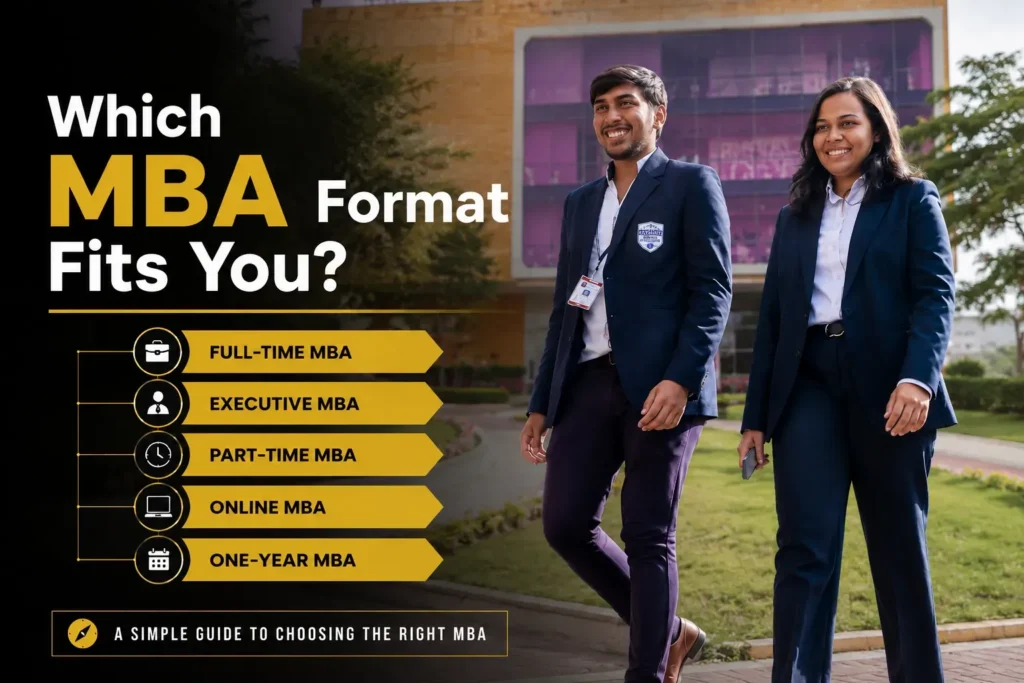
The main MBA formats in India are: full-time (two years, campus-based, with placements), executive (for professionals with 5+ years of experience), part-time or weekend (study alongside work), online (fully remote delivery), and the one-year accelerated MBA (intensive, usually for experienced candidates). They differ in duration, cost, recognition, placement access, and who they are designed for – and choosing the wrong format is one of the most expensive mistakes an MBA applicant can make.
Walk through the admission pages of top MBA colleges in Bangalore and you will meet all five formats, often described in language designed to make each sound right for everyone. They are not. Each format solves a different life situation.
This decoder lays out what each version of the MBA at top MBA colleges in Bangalore actually involves – recognition, cost band, placement access, and the candidate each one genuinely fits.
The 5 MBA Formats Compared
| Format | Duration | Typical Cost Band | Placement Access | Designed For |
| Full-time MBA | 2 years | ₹3 – 25+ lakh | Full campus placements | Freshers and early-career professionals (0–5 years) wanting the complete transformation: peers, internships, recruiters |
| Executive MBA | 1 – 1.5 years | ₹8 – 30 lakh | Career services, rarely campus drives | Professionals with 5–10+ years targeting senior roles; often employer-sponsored |
| Part-time / weekend MBA | 2.5 – 3 years | ₹2 – 8 lakh | Limited or none | Working professionals who cannot pause employment and want a recognised credential |
| Online MBA | 2 years (flexible) | ₹1 – 5 lakh | None or virtual-only | Self-driven learners prioritising flexibility and cost over campus and placements |
| One-year accelerated MBA | 1 year | ₹10 – 30 lakh | Varies by institute | Experienced professionals wanting speed; check recognition carefully |
Read the placement column twice. It is the single biggest differentiator between formats – and the detail most applicants discover after enrolling.
The Recognition Question: Which Formats Count Where
Not all five formats carry equal weight everywhere. Three checks settle the recognition question for any program:
- AICTE approval or university affiliation. A full-time MBA approved by AICTE and affiliated with a recognised university (such as Bengaluru City University) is the gold standard for both employers and further study.
- UGC entitlement for online degrees. Online MBAs are valid only when the awarding university is entitled by UGC to offer online degrees. Verify on the university’s entitlement listing, not the brochure.
- Degree versus diploma. Some one-year and executive programs award a diploma or certificate, not an MBA degree. Both can be valuable – but they are different documents, and government roles or doctoral admissions may treat them differently.
One sentence protects you through every conversation: “Please confirm in writing the exact name of the qualification awarded and its approving body.”
How to Choose: Match the Format to Your Situation
- You are a fresher or have under 5 years of experience: full-time. Campus placements, internships, and the peer network are the product – no other format includes them fully.
- You have 5–10+ years and your employer values the credential: executive, ideally employer-sponsored. You are buying senior-level frameworks and a professional network, not placements.
- You cannot pause income and placements matter less than the credential: part-time or weekend. Slower, cheaper, recognised – and compatible with a salary.
- You need maximum flexibility at minimum cost: online, from a UGC-entitled university only. Treat placement claims with heavy skepticism.
- You want speed and have experience: one-year accelerated – after verifying whether it awards a degree or a diploma, and what that means for your goals.
The most common mismatch: working professionals defaulting to online because they assume full-time means quitting. It increasingly does not – which is the gap a sixth model fills.
Cost Per Outcome: The Comparison That Settles Format Debates
Sticker prices mislead because the five formats buy different things. Compare them on cost per outcome instead.
- A ₹2 lakh online MBA with no placement access can cost more, in career terms, than a ₹6 lakh full-time program that converts into a job – the cheaper option is only cheaper if you already have the job
- An executive MBA pays off through promotion velocity at your current employer; if your employer will not recognise it, the premium evaporates
- A part-time MBA’s real cost is three years of evening and weekend hours – count that honestly
- At top MBA colleges in Bangalore, the full-time format carries the highest sticker price relative to online but the lowest cost per placed graduate, because the placement machinery is the product
The format question, run through this lens, usually answers itself within minutes.
The Sixth Model: Full-Time, Without the Career Break
A structural innovation now sits between full-time and part-time: the earn-while-you-learn full-time MBA. The degree is a standard two-year, AICTE-approved, university-affiliated MBA – full recognition, full placement access – but the program is structured so students earn through internships, live projects, and industry-integrated schedules while studying.
This is the model Arihant Group of Institutions (AGI) runs at its Global Campus, Thalaghattapura. The MBA – AICTE-approved, affiliated with Bengaluru City University, and recognised as Most Promising B-School 2025 – combines:
- Earn-while-you-learn structure, so working professionals and self-funding students keep an income through the program
- Specialisations in Finance, Marketing, and Human Resources, taught through case studies, simulations, and live projects
- Industry tools training: Power BI & Tableau
- Full placement preparation and recruiter access through the Industry Institute Partnership Cell (IIPC)
- International exposure trips included in the program fee
- Entrance through PGCET, KMAT, MAT, or CMAT – no CAT requirement
For the large group of applicants torn between “online because I need income” and “full-time because I need placements,” this structure removes the trade-off.
Key Takeaways
- Five MBA formats serve five different situations – full-time, executive, part-time, online, and one-year accelerated
- Placement access is the biggest hidden differentiator: full campus placements come standard only with full-time programs
- Verify recognition in writing: AICTE approval, university affiliation, UGC online entitlement, and degree-versus-diploma status
- Match format to experience: freshers belong in full-time; 5+ year professionals fit executive or part-time; online suits flexibility-first learners
- Earn-while-you-learn full-time programs at top MBA colleges in Bangalore now offer full recognition and placements without the career break
Picking Your MBA Format at Top MBA Colleges in Bangalore: Your Next Step
Write down your constraint – income, time, experience level, or placement need – and let it pick the format before you pick the college. Then shortlist three top MBA colleges in Bangalore offering that format and verify recognition in writing.
To explore the earn-while-you-learn full-time MBA at AGI – eligibility, specialisations, and how the income-plus-placements structure works – visit agiedu.in or call +91 92363 63636.
FAQs: MBA Formats at Top MBA Colleges in Bangalore
1. What are the 4 types of MBA?
The four classic formats are full-time (two years, campus placements), executive (for experienced professionals), part-time or weekend (study alongside work), and online (fully remote). A fifth – the one-year accelerated MBA – is increasingly common. They differ mainly in duration, cost, placement access, and the experience level they are designed for.
2. What is the difference between an executive MBA and a full-time MBA?
A full-time MBA is a two-year immersive program with internships and campus placements, designed for candidates with 0–5 years of experience. An executive MBA compresses senior-level frameworks into 1–1.5 years for professionals with 5–10+ years, usually without campus placements – the value is the credential and network, often employer-sponsored.
3. Is an online MBA from Bangalore worth it?
It can be, for the right candidate: someone prioritising flexibility and cost who does not need campus placements. Verify the awarding university holds UGC entitlement for online degrees, and treat placement promises skeptically – online formats rarely include genuine recruiter drives. For placement-dependent candidates, full-time remains the stronger format.
4. How much does a 1-year MBA cost in India?
One-year accelerated programs at established institutes typically cost ₹10–30 lakh, positioning them among the most expensive formats per month of study. Before paying, confirm whether the program awards an MBA degree or a postgraduate diploma, as the distinction affects further study eligibility and some employer policies.
5. Which MBA format is best for working professionals in Bangalore?
It depends on what you need. If the credential alone suffices, part-time or executive formats fit well. If you also need placements and full recognition without quitting, an earn-while-you-learn full-time MBA – such as the AICTE-approved, Bengaluru City University affiliated program at Arihant Group of Institutions – delivers both income continuity and complete placement access.