
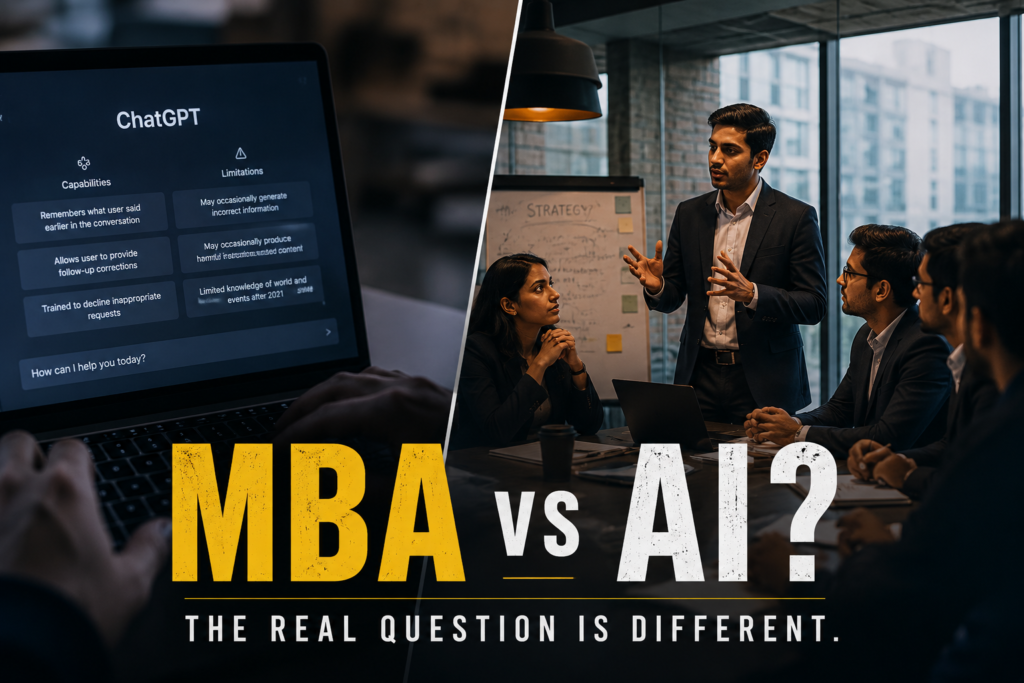
No – AI will not replace the MBA, but it is rapidly replacing parts of what MBA graduates used to be hired for. Routine analysis, report drafting, and first-pass research are increasingly automated. What survives, and grows more valuable, is the judgment layer: framing problems, making decisions under uncertainty, leading teams, negotiating, and knowing which AI output to trust. The MBA worth doing in 2026 is the one that teaches you to manage with AI, not compete against it.
It is the question quietly sitting behind every admission enquiry this year. Families are about to commit two years and several lakhs, and they want to know whether the degree survives the decade. The answer depends almost entirely on what top MBA colleges in Bangalore actually put inside the curriculum.
This article separates the AI-proof skills from the AI-exposed ones, and shows you exactly what to look for when evaluating top MBA colleges in Bangalore on this question – including the curriculum questions most applicants never ask.
What AI Is Already Doing to Entry-Level Management Work
The honest starting point: a meaningful slice of what fresh MBA graduates did in 2018 is now machine-assisted. Recruiters in Bangalore – home to a dense concentration of IT firms and Global Capability Centres – see it daily.
- First-draft market research and competitor summaries are generated, not assembled by analysts
- Standard financial models and variance reports are increasingly templated and automated
- Routine campaign reporting in marketing runs through dashboards, not weekly decks built by juniors
- Basic HR screening and scheduling workflows are automated at most large employers
None of this eliminates the manager. It eliminates the version of the job that was mostly assembling information. The role that remains starts where the dashboard ends.
The Skills AI Cannot Replace – and the Ones It Already Has
| AI-Exposed (Automating Now) | AI-Proof (Growing in Value) |
| Routine data compilation and formatting | Framing the right business problem before any analysis begins |
| First-draft reports, summaries, and decks | Judgment under uncertainty – deciding with incomplete information |
| Standard financial and campaign reporting | Negotiation, stakeholder management, and persuasion |
| Basic forecasting from clean historical data | Leading teams through change, conflict, and ambiguity |
| First-pass screening and research | Ethical judgment and accountability for decisions AI cannot own |
A useful rule: AI replaces tasks with a clear right answer and abundant data. It cannot replace accountability. Someone still signs the decision – and companies pay a premium for people qualified to sign.
How AI Reshapes Each MBA Specialisation
- Finance: routine reporting automates; valuation judgment, risk interpretation, and fintech fluency gain value
- Marketing: campaign reporting automates; strategy, brand judgment, and the ability to direct AI-generated creative gain value
- Human Resources: screening and scheduling automate; organisational design, people analytics interpretation, and change leadership gain value
No specialisation is “safe” or “doomed.” Each is splitting into an automated layer and a judgment layer – and the judgment layer pays better than the old combined role ever did.
What Top MBA Colleges in Bangalore Should Be Teaching in 2026
Curriculum is where the “will my MBA survive” question gets answered. The programs preparing students properly share four visible features:
- Tool fluency built into coursework. Students graduate hands-on with Power BI, Tableau, SPSS, CRM, and ERP platforms – the systems AI plugs into – rather than meeting them for the first time at work.
- Case-and-simulation pedagogy. Decision-making under messy, incomplete information cannot be learned from lectures. Case studies, simulations, and live projects train the judgment layer directly.
- Real industry exposure. Live projects, industrial visits, and internships put students inside workflows where AI is actually deployed – the only place to learn which outputs to trust.
- Human-skill development as a graded component. Communication, negotiation, leadership, and teamwork treated as core training, not an optional add-on week.
When you visit campuses, ask one forcing question: “Show me where in the curriculum students use analytics tools on real business problems.” A program that answers with a course code and a project list is ready for 2030. A program that answers with a brochure adjective is not.
How AGI’s MBA Answers the AI Question
The MBA at Arihant Group of Institutions (AGI) – a two-year, AICTE-approved, Bengaluru City University affiliated program at the Global Campus, recognised as Most Promising B-School 2025 – is built around precisely the four features above.
- Industry tools training across Power BI, Tableau, SPSS, CRM, and ERP woven into the program, so graduates arrive fluent in the analytics stack employers run AI on top of
- Pedagogy built on case studies, simulations, industrial visits, and live projects – judgment training, not lecture-only delivery
- Specialisations in Finance, Marketing, and Human Resources, each taught with applied, decision-centred coursework
- Structured human-skills development: business communication, leadership, teamwork, and personality development through the program
- Placement preparation through the Industry Institute Partnership Cell (IIPC), aligned to what Bangalore recruiters – including its Global Capability Centres – now screen for
- International exposure trips included in the program fee, adding the cross-cultural management context AI cannot supply
The design principle is simple: teach students to direct the machine, judge its output, and own the decision. That combination is what stays employable.
So Is an MBA Still Worth It in 2026? The Honest Verdict
Yes – with one condition. A lecture-only MBA that produces graduates who compile information is depreciating fast. An applied MBA that produces graduates who frame problems, run analytics tools, and lead people is appreciating, because AI makes exactly those people more productive and more valuable.
The question to carry into admission season is not “Will AI replace my MBA?” It is “Does this specific program teach the layer AI cannot do?” Some top MBA colleges in Bangalore can show you that layer in their curriculum. Choose from those.
Key Takeaways
- AI is automating routine analysis and reporting – the tasks, not the manager’s accountability
- AI-proof skills: problem framing, judgment under uncertainty, negotiation, leadership, and ethical decision ownership
- Evaluate programs on four features: tool fluency in coursework, case-and-simulation pedagogy, live industry exposure, and graded human-skill training
- Ask every college to show where students use analytics tools on real business problems – course codes, not adjectives
- The MBA worth doing teaches you to manage with AI; top MBA colleges in Bangalore that do this are appreciating assets, not depreciating ones
Choosing an AI-Ready Program at Top MBA Colleges in Bangalore: Your Next Step
Shortlist programs, then audit each curriculum against the four features above. The degree survives the decade when the teaching does.
To see how AGI’s MBA builds tool fluency, judgment training, and IIPC placement preparation into the two years – visit agiedu.in or call +91 92363 63636 for a curriculum walkthrough at the Global Campus, Thalaghattapura.
FAQs: AI and Top MBA Colleges in Bangalore
1. Will MBA be replaced by AI?
No. AI is automating routine MBA-graduate tasks – data compilation, first-draft reports, standard analysis – but it cannot replace problem framing, judgment under uncertainty, negotiation, leadership, or accountability for decisions. The MBA remains valuable when the program explicitly teaches that judgment layer alongside fluency in the tools AI runs on.
2. Which MBA skills are AI-proof?
The skills that grow in value are framing the right business problem, deciding with incomplete information, stakeholder management and negotiation, leading teams through change, and ethical ownership of decisions. These survive because they carry accountability – something no organisation delegates to software.
3. What tools should an MBA teach in 2026?
Graduates should leave hands-on with the analytics and enterprise stack employers deploy AI on top of: Power BI and Tableau for visualisation, SPSS for statistical analysis, and CRM and ERP platforms for business operations. At Arihant Group of Institutions, this tool training is built into the MBA coursework rather than left to post-placement learning.
4. Is an MBA still worth it in 2026?
Yes, conditionally. An applied MBA – case studies, simulations, live projects, tool fluency, and human-skill training – is appreciating in value because AI makes judgment-capable managers more productive. A lecture-only program producing information compilers is depreciating. Evaluate the specific curriculum, not the degree category.
5. What are the disadvantages of an MBA today?
The honest ones: two years of cost and time, uneven program quality across institutions, and the automation of routine entry-level tasks that older curricula still train for. Each is manageable – choose an applied program with tool training, verify placement structure through a named cell, and run the payback math before committing.